

A UK-based pharmaceutical company specializing in personal care treatments was operating with a process that worked, but wasn’t fully scalable.
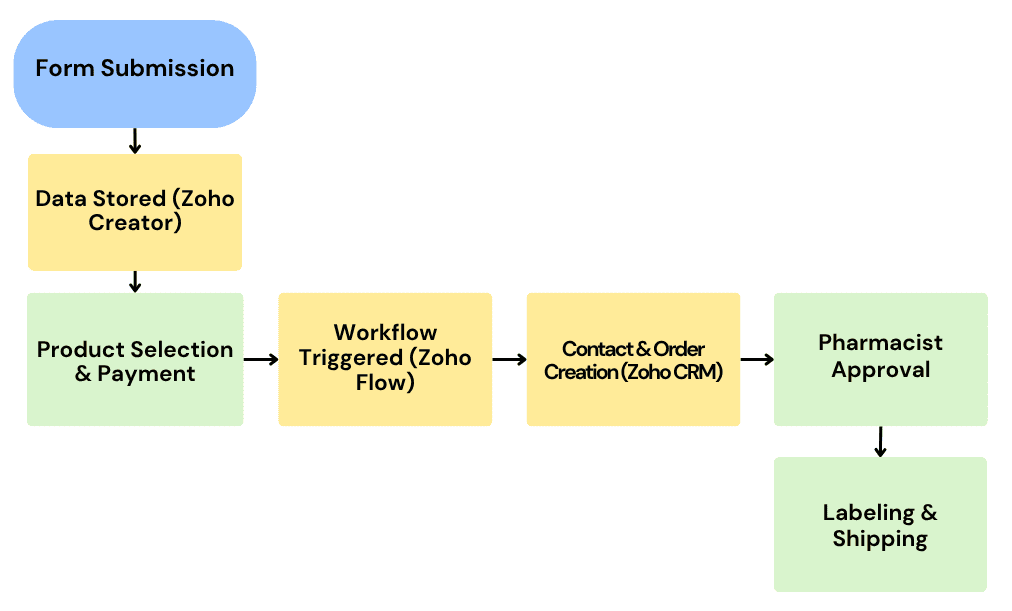
Its operation was simple: users filled out a specific form for each product on the client's website, then were redirected to Shopify to complete the purchase, and once the order was created, a pharmaceutical specialist manually reviewed each case before its approval and shipment.
What was limiting the process?
As the business grew, several challenges became more apparent.
Regular customers had to fill out the same forms repeatedly, as there was no mechanism to pre-populate their data. Order tracking was complicated across all systems, and there was no clear visibility into customer behavior or operational performance.
At the same time, the medical team lacked an efficient interface for reviewing patient information, which unnecessarily slowed down the validation process and made the time spent on it inefficient.
The company needed a system that connected all processes, from data capture to order processing and was flexible enough to adapt to changing medical workflows.
Building the Foundation with Zoho One
The solution was developed using Zoho One, integrating Zoho Creator, Zoho CRM, Zoho Flow, and Shopify into a single ecosystem, showcasing Zoho's strength in enabling seamless integrations.
The first step was to recreate the data capture layer. Instead of using traditional web forms, all forms were rebuilt in Zoho Creator using custom widgets. This allowed for greater control over the interface, improved validation of medical data, and the ability to create dynamic experiences based on user interaction. Most importantly, it laid the foundation for structured and reusable data.
Connecting Shopify and CRM
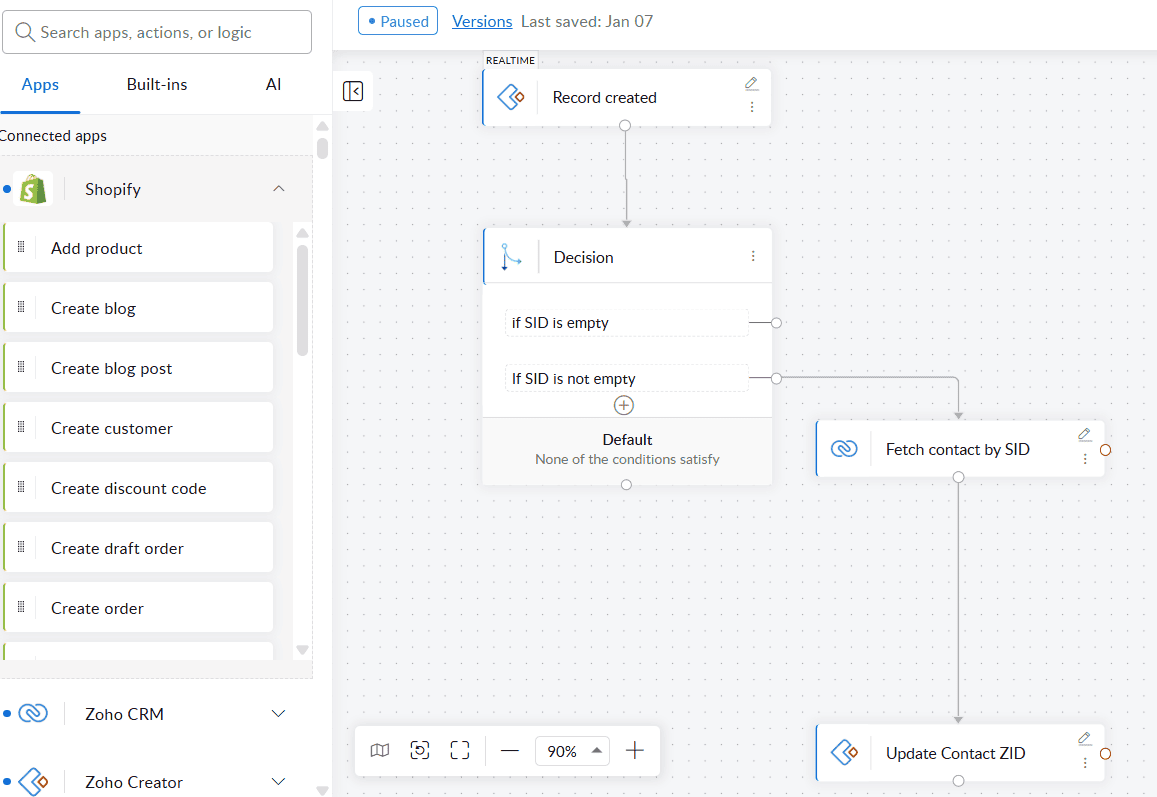
Once the front-end was in place, the next step was integration. Shopify remained the platform for checkout and payments, but it became part of a larger workflow. Using Zoho Flow, every completed purchase in Shopify triggers an automated process.
Behind the scenes, the system evaluates whether the customer already exists. If not, a new contact is created in Zoho CRM along with a deal representing the order. If the customer is already in the system, only a new deal is generated and linked to the existing record.
From Order Creation to Medical Validation
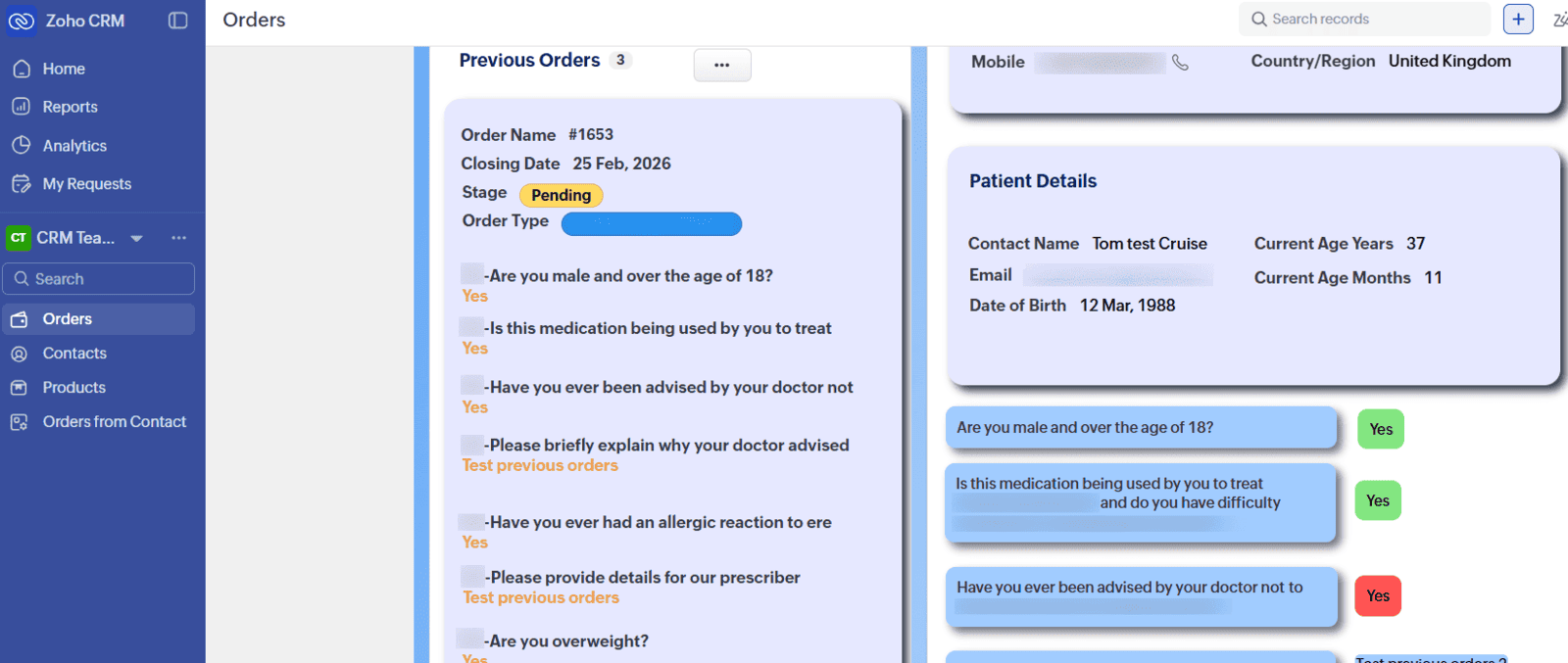
Once an order arrives in Zoho CRM, it enters a structured lifecycle: Each order is stored as a transaction and begins in the "Pending Review" stage. From there, pharmacy specialists access the record and review all the patient information collected during form submission.
To optimize this process, the CRM interface was customized using Canvas. Instead of a standard layout, the information is visually organized, highlighting key data and using color indicators (green, yellow, and red) to help specialists quickly assess patient eligibility.
Automation that optimizes the process
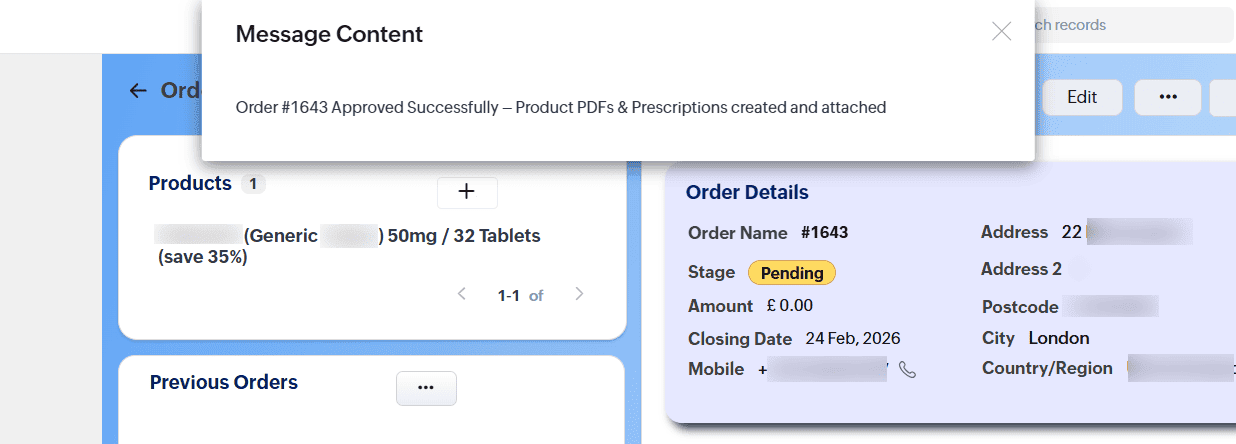
In addition to the main workflow, several complementary automations were implemented to improve accuracy and efficiency.
What Changed After Implementation
What was once a fragmented process has become a fully integrated workflow with high growth potential.
Now, data flows seamlessly from the moment a user interacts with a form until the final product delivery. The customer experience has improved thanks to smarter and faster interactions, especially for returning users. The medical team has gained a much more efficient way to evaluate cases, and the company now has complete visibility into its operations.
Final Thoughts
Zoho One enabled the connection of multiple platforms into a unified solution without sacrificing flexibility. Thanks to its integration with Shopify and the proper structuring of data, the company now has a scalable foundation that supports both operational efficiency and future growth.
The biggest impact doesn’t come from replacing everything, but from connecting everything the right way.
